
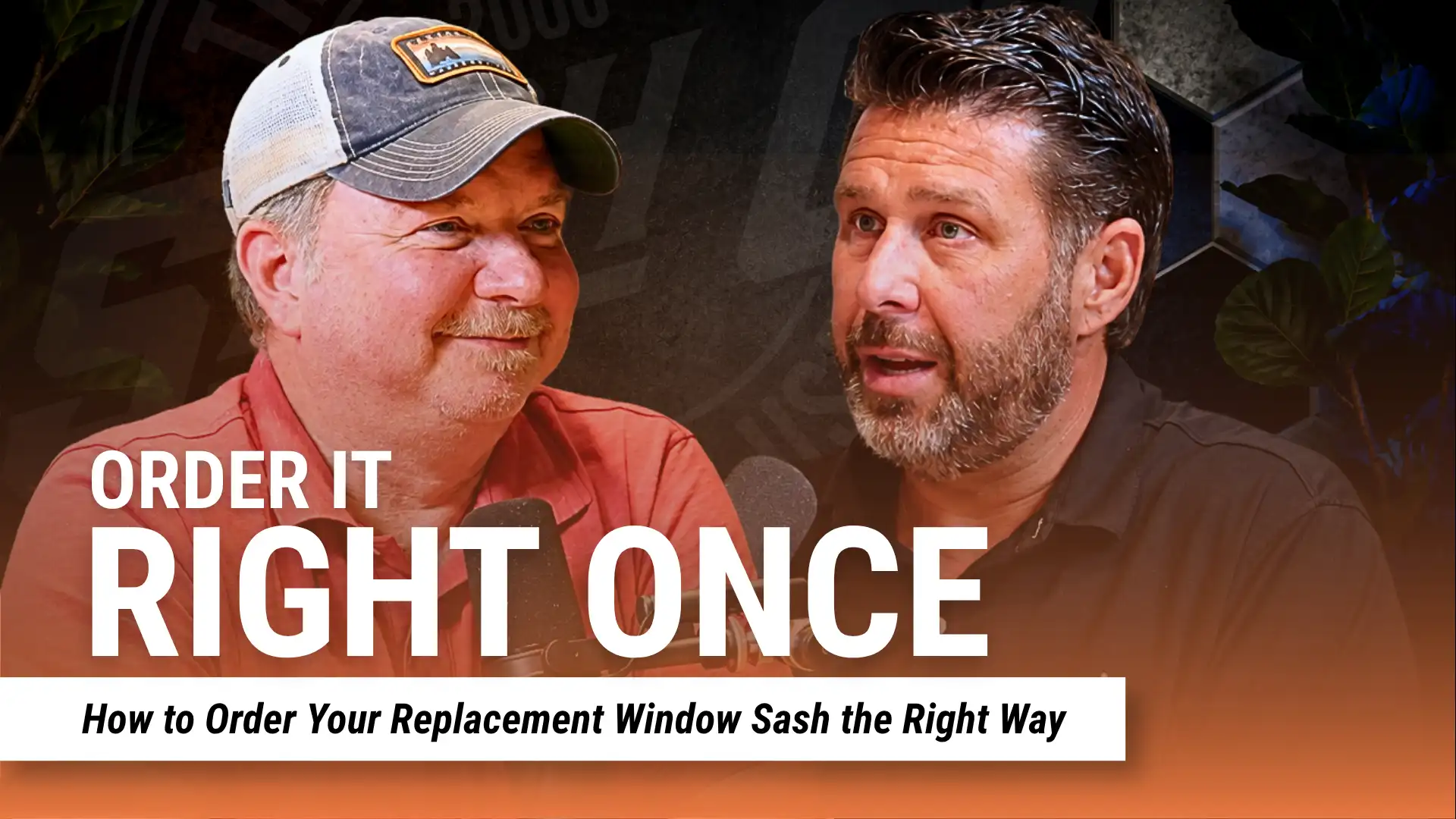
Ordering a custom sash shouldn’t feel like a gamble
Picture this: a sash in your 30-year-old window has gone soft, and you’re staring at a long quote request wondering if you’ll order the wrong thing. You’re not alone. In this episode from episode 005 of the Fenster Sash Cast, Ryan and Jason go through the quote request one question at a time. The core idea: a little knowledge up front means you order the right sash once, and save 50% or more versus replacing the whole window.
Glass is the part you’re really paying for
According to Ryan, glass is about 60% of the cost of a replacement sash, and the wood is the next biggest piece. Fenster uses Cardinal Glass, and everything is double pane, because triple pane is thicker than the original frames it has to match. Tempered glass is a building code requirement, not an upgrade. You need it over a bathtub, in a stairwell, within 18 inches of the floor, or beside a swinging door. Not sure what you have? Ryan’s rule of thumb: if your home was built before 1995, it’s probably standard clear glass. And while it’s tempting to reuse the old glass, Ryan puts it bluntly: “Your glass isn’t good. It just hasn’t failed yet.” Handling it during a rebuild is the number one way to break the seal.
Skip what you don’t need
Ryan’s advice is to save your money on the extras. Sashes don’t come with new hardware, so if your crank and hinges work, transfer them over. Handing orientation isn’t required, because every sash is the same panel. The weather stripping around the edge is a storm shield, not your thermal barrier. The vinyl bulb on the frame does that job. And please, don’t paint them until you’ve test-fit one. As for timing, Ryan says a sash takes a day or two to build plus about a week for glass. The rest is your place in line and a delivery route, since Fenster loads its own truck and drives your order to you. Every sash also carries a 10-year warranty.
Key takeaways
- Glass is about 60% of the cost, so it’s where your decisions matter most.
- Tempered glass is required by code in specific spots, not a quality upgrade.
- Pre-1995 homes probably have standard clear glass.
- Reuse your working hardware and don’t worry about left or right-handing.
- Test-fit one sash before you paint any, and watch the install videos first.
Watch the full episode on YouTube. Ready to get started?
EPISODE TRANSCRIPT
Ryan: Give me 15 minutes and I’ll save you 50% or more on your next window project. Is it a sales pitch? No. It’s a 15-minute commitment we’re asking of you, our customer, to educate yourself on window repair. And we’re going to show you how to do it. Let’s get started.
Ryan: Ordering window sashes seems like a complicated process. It comes with a level of anxiety over spending money on something you can’t use, or something you might order wrong. But it doesn’t have to be. In this episode, we’re taking a deep dive into window terminology and window components, and unpacking some of our most commonly asked questions. We want to give you the tools to be a confident consumer and save 50% or more on your next window project. That’s what we’re going to talk about.
Ryan: Here we are again.
Jason: Yeah. Been a minute.
Ryan: Life good?
Jason: Yeah.
Ryan: We don’t really talk about dates of when we’re filming, but we’re in the height of our season. Pretty busy.
Jason: I concur. I’ve been quite busy myself, and I’m happy to spend the day. A little time off the road.
Ryan: Time off the road. Yeah.
Jason: You talked about breaking it down. All the little decisions people need to make, the concerns, the fears, everything else. How do you want to roll into some of those things?
Ryan: I saw this episode as one big chunk of information. And I want to express some frustration we have internally. It’s part of that customer service journey: how do we best educate our customers so they understand what they’re buying and what we make? We want to give them the tools and the confidence to order those products correctly and efficiently.
There’s a specification section on our website that gives you the nuts and bolts of what our products are, how they’re made, and some of the choices you have to make as the customer along the way. Some of that we spoon-feed to you. Some of it, we expect you to come to the table with some knowledge, or to have done some research.
Jason: Jerry Maguire said it. “Help me help you.”
Ryan: We use that term a lot, and it really does come from the heart. We are constantly trying to improve that process for our customer. As tight a ship as we run, the more a consumer can do on their own, the easier it is on us, easier on them, faster, more efficient, yada, yada, yada.
Some of this is nuts and bolts. And some of this is an effort to figure out, through these episodes, the best way to deliver this information. Because the most frequently asked questions I get after an RFQ are the same questions, over and over and over again. We’ve been around the block. We’ve done our best to address these questions. Sometimes they’ve been answered in two or three different places, as you’re filling out the quote request or looking around the website. But I still get the same questions. So this is putting it back out into the universe. What are the touchpoints on these specifications that people need to get into their heads a little better? Or is there a better way for us to communicate it?
Jason: So we’re trying to help them learn our vocabulary a little better.
Ryan: That’s exactly right. I don’t want to get real technical and window-geeky. A lot of the terminology I want to talk through is about how a homeowner would use that information or understand it.
Jason: Cool. Well, let’s jump in.
Wood
Jason: What kind of wood do y’all use? Is there anything special about the wood we use compared to anybody else?
Ryan: There is, and there isn’t. Let’s go through the basics first. We use a combination of pine and poplar. Those species are specific to the window industry. At the core of it, we’re just trying to match what you already have.
Pine was the primary species used in the window industry. Nine and a half times out of ten, your windows were made out of pine. If you have a wood sash, a stain-grade sash, that’s going to be clear eastern white pine. That’s the species we use, for the economy of it.
If you have a clad, paint-grade window, that’s what we use the poplar for. The cladding gives added protection on the exterior side. You’re painting over it, so it doesn’t have to be pretty. Poplar is great to work with from a millwork standpoint, but it’s not as stainable. It’s not as pretty as clear pine. So we use it for the other side.
There’s supply chain and economy of scale behind that too. I get, “Well, can I get mahogany? Can I get oak?” Sarcastically, I say, “Well, if mahogany is so great, why didn’t they make the window out of that in the first place?” Because you probably have pine windows, which I said was the industry standard.
And like you alluded to earlier, because of the size company we are and the buying power we have, we have supplier agreements in place. We’ve negotiated pricing based on a certain volume of materials. I can’t go out and buy 2,000 feet of oak because you want two windows made out of oak. That just doesn’t make sense for us as a company. So that’s the technical explanation. The type of wood really isn’t a choice the customer gets to make.
Finishes
Jason: So we’ve talked about wood. Finishes?
Ryan: Finishes. When you’re on the order form, the quote request, you’re given a choice: is it bare for stain, or is it primed for paint? On the exterior side, you can get clad, or pre-primed. I think it actually says “painted.” What those questions are asking is: what’s the finished result supposed to be?
If you’re going to stain and seal, you want the bare pine. They don’t come pre-painted as standard. We pre-prime them if you’ve selected the painted choice. You get a coat of primer, sanded once, paint-ready for your finish coat.
Now, we do offer a pre-painted option. But the price we charge for pre-painting is reflective of us not wanting to paint. We’re not in the painting business. We’re not painters. We build windows. It’s a service we provide for the customer who wants to pay for that upgrade, but it’s literally a “we don’t want to do it” price.
Jason: That’s full disclosure.
Ryan: Full disclosure. Our pre-paint number is “we really don’t want to do that.” You’ll probably hire a local painter for a much more reasonable price. But there’s a big convenience factor. Some customers say, “Hey, it’s one more contractor I don’t need to involve.” I see the convenience. So it’s there if you ask for it.
Glass
Jason: We’ve got wood, we’ve got finish. What’s special about our glass?
Ryan: The glass. I want to spend quite a bit of time on this. Some of these we’ll breeze through because there’s not a lot to talk about, but there’s a lot to unpack on glass.
I want to combine the glass conversation with the wood, which I glossed over. The glass is the technology you’re buying. The rest of the window, the wood, the cladding, the weather stripping, hasn’t changed in 40 or 50 years of window manufacturing. It’s the glass that has evolved. Your glass is about 60% of the cost.
The wood is the next most expensive part. What I didn’t mention earlier is what we’re doing better. A lot of windows going back to the late ’90s and early 2000s used finger-jointed material. They took little pieces and glued them together, and the finished side just had a thin veneer on it. Part of what drives our price point is that we use solid lengths of lumber. You’re talking about a solid chunk of pine this big to make a window. That’s not pennies. That’s whole dollars per foot.
Let’s break down some technical terms on glass. I get this a lot: “What’s different about your glass? What kind of glass are you using?” Being a small company doesn’t mean we’re using lesser materials. We use Cardinal Glass, which is probably the largest manufacturer of raw glass in the United States. It’s a name-brand product. Any big window company you want, they’ve got Cardinal Glass in their product line. We’re using the same glass all the big boys are using.
Everything is double pane. There’s no point in making a single-pane window anymore. Most people are at least trying to match what they had, or they’re looking for an upgrade in efficiency.
Triple pane is more of an anomaly in the industry. My 25 years of professional opinion says it’s just a sales pitch. I understand the point of three panes. You’re tripling up on the efficiency, on the Low-E coating. You have more surfaces that coating could be applied to. The problem is that triple pane affects how thick your window frame has to be. When we’re replicating a former product as an aftermarket product, matching those same dimensions, you can’t just cram three panes of glass where two panes used to be. Dimensionally, that doesn’t work with the products we’re replicating.
Now, if we want to dissect where the efficiency comes from, there are two numbers people look at when they’re judging the quality of glass. You’ve got the U-factor, and you’ve got the solar heat gain coefficient.
Jason: Fancy terms. Say that four times fast.
Ryan: You can’t. Here’s the easiest way to break it down. The U-factor is your insulation value. How well does the window insulate? The solar heat gain coefficient reflects how much heat transfers through the glass from the outside. I read a great article on how to explain this. Picture your window, inside to outside. The U-factor is the energy going from the inside out. The solar heat gain coefficient is the energy from the outside coming in.
I don’t want to get too geeky, but then you get into coatings. Low-E is an actual coating on the glass itself. Take a double-pane unit. You have four surfaces: the outside of the outside pane, the inside of the outside pane, and so on. I don’t have any pie charts with me. A lot of times your Low-E coating is on surface two, the inside of the outside pane. Everyone has their opinion on what’s best, but surface two is kind of the norm. It gives you the best solar heat gain coefficient rating.
Jason: Stopping heat from coming in through the window.
Ryan: Right.
Another question I get: how are the two panes put together? A lot of people think there’s some kind of gas in there, or it’s a vacuum. Argon is a separate thing. A normal double-pane unit is just two panes glued together with a spacer in between that sets how thick the unit is. It’s dead air space. There’s nothing in there. Now, argon fill is an upgrade. They actually inject argon gas in there. So with argon fill, you do have gas in there. Otherwise, there’s nothing.
We use Super Spacer, which is a top name brand. It’s a rigid, silicone-based spacer that sticks the two panes together, and then a hot rubber sealant fills in around the edges. As the glass unit ages, that rubber sealant gets old and brittle, starts to dry out, and you get a little crack. That crack lets air transfer in and out. What you’re seeing is moisture and humidity getting in between the panes. It leaks in, but it won’t leak back out. It condenses, and over time it builds up a residue. That’s what you’re seeing as cloudy, foggy glass.
Reusing Old Glass
Ryan: I want to touch on another one I get a lot: “My glass is good. Can I just get the frame and reuse the glass?” I’m going to tell you why that’s a bad idea. Your house is 30, 40 years old. Your glass isn’t good. It just hasn’t failed yet.
What happens is you’re trying to take that frame apart and sandwich a new frame around the glass. You’re manhandling it. It’s twisting. It’s laying on a table crooked. That’s your number one chance to break the seal. I’d make that friendly argument with anyone who says their 30-year-old glass is good, because 30 years ago, that glass probably had a 10-year lifespan. You’ve already gotten three times the life out of it. Once you manhandle it, the odds of it staying uncompromised aren’t good. What I’m trying to avoid for the customer is this: you tried to save money by fixing one part, and you broke the other part. In the long run, start fresh. Start over with a brand-new product.
Tempered Glass
Ryan: So that’s glass construction and the technical terms. Let’s talk about tempered glass. Tempered glass is a building code requirement. It’s not an upgrade. A lot of folks think they’re getting better glass with tempered glass. Safety tempering is a heat-treating process. If that glass breaks, it shatters into a billion little crumbles. You don’t ever want to break a piece of tempered glass. You’ve got a mess on your hands. But it won’t break into shards. It’s a safety concern.
Jason: Tempered glass won’t kill you when it breaks.
Ryan: It won’t break into daggers.
Jason: Jason Voorhees daggers.
Ryan: Right. That’s the thought behind it. Building codes are different all over the country, but there’s a model building code that works pretty much everywhere. Some examples: a window over a bathtub has to be tempered. A window in a stairwell has to be tempered. And this gets a little technical: if the glass is lower than 18 inches from the floor. That’s the glass, not the frame. A lot of windows sit that low, but you’re not measuring to the trim. You’re measuring to the glass itself. Tempered glass goes anywhere it’s prone to being hit by something.
Jason: More so than a higher window.
Ryan: Right. Low to the ground. And the last most common one: a window next to a door that swings, where the window is within the swing. The door swings open and the handle goes through the glass. That has to be tempered.
So: safety requirement, building code requirement. Not necessarily better. And it is considerably more expensive to have that process done. Don’t buy it if you don’t need it. We’re always trying to save our folks money.
Impact-Rated Glass
Ryan: That takes us into impact-rated glass. We don’t do a lot of business in South Florida or on the deep Southern coast, because building codes there in the last few years require that even if you’re repairing a window, you go back with impact-rated glass. That glass has a coating on it. If you threw a two-by-four through it…
Jason: Like a car windshield.
Ryan: Along those lines. It’s still going to break, but it’s not going to shoot the tree branch into the house.
At the stage of company we are right now, and with the fabricator we use here in the Midwest, it doesn’t make sense. Nobody buys impact-rated glass in the four-state area they supply, so they don’t stock it. It’s literally a supply chain issue for us. As of 2026, we don’t have it available.
I had one guy in Michigan ask for it. I said, “Why do you want impact glass?” They lived on a golf course. Their house backed up to it. I said, “Oh. I never thought about that.”
Which Glass Do You Have?
Ryan: Let me get into glass choices, because this is a gray area for a lot of folks. The common questions: How do I know what kind of glass I have? Is it Low-E? Is it Low-E with argon?
You don’t know that, and we don’t know that. You’d need special sensors. Now, tempered glass is supposed to be marked. It should have an etching on the glass that says it’s tempered. So if you know where to look, or you apply the rules for where tempered is required, you can walk that through. But Low-E versus clear, you’re not going to know, and neither are we.
Here’s my rule of thumb, and it’s just my opinion, my two cents. There’s no technical data behind it. My rule of thumb is 1995. If your home was built before 1995, it’s probably standard clear glass. Low-E technology existed, but it was a very expensive upgrade. So if you’re just trying to match what you’ve got, that’s my rule.
Late ’90s, early 2000s, that’s your gray area. I put new Andersen windows in my house in 2004, and it’s still just clear glass. I don’t even have Low-E. That’s the general play. The newer you get, the more likely it’s Low-E. Same with argon fill. In the mid-to-late ’90s, it was a very expensive upgrade. Now it’s more commonplace.
Jason: A more common option.
Ryan: Right. When it comes to coaching our customers on how to choose, we’re offering a good, better, best. Clear glass is good. Low-E is better. Argon fill is best. Some people just want to know: what’s the cheapest, and what’s the most expensive?
This is where we want our customers to do a little research on their own. You get way out in the weeds when you start talking about different Low-E coatings and U-values. We’re not trying to reinvent the wheel with our glass. Some people want to match what they have. Some people want to upgrade. Our standard Low-E, which is basically what I’m quoting on the everyday order, is 10 times better than what 1995 was. Ten times better than anything you’re trying to replace. So you’re automatically upgrading what’s on your house.
Now, some people want the Cadillac. Some people want the BMW. Then get the argon fill. Does it help on the efficiency ratings? A little. Believe it or not, argon fill does more for sound control than it does for energy values. The studies show it helps the most on sound. We’ve had customers say, “We hardly hear anything off the street anymore.” They probably got the argon-filled glass and are seeing the benefit.
Where I talk some people off the ledge is when they’re buying one or two. There’s no point spending extra money on one nice window in your house. You’re never going to see the value. It’s the folks doing a whole side of the house, or the whole house, where it’s probably a good idea to go with the better glass. Are we going to cut your energy bills in half? No. That’s sales pitch garbage. That never happens. But will you see the benefit of the better glass options on a whole house? Yes. On small quantities? No. I try to talk people out of it. We’re constantly trying to save people money.
The last thing I’ll touch on with glass, and then we can move on. Our typical customer just needs a reasonable, economical solution for the window that just fell out into the yard, rotten. “Hey, I need a sash to put back in the hole.” I’m not saying I don’t spend time with these folks. But I get some folks who are all up in me about “this company has this U-rating, and that company has that.” That’s great. You’re probably a candidate for all-new windows, because we’re not trying to compete on glass efficiency.
We exist solely to give the customer a reasonable repair option when they need one, two, five sashes, all the way up to, “Why would I buy all-new windows? I can do the whole house for a third of the price and still get better quality than I had before.” That’s the top end of the bell curve for us. Everybody else is saying, “Man, send me something. I’ve got to plug the hole up.”
We affectionately call them Gary Googles. Folks who’ve spent way more time on the internet than they probably needed to. And there’s nothing wrong with that. I’m just saying, Mr. and Mrs. Customer, you’re probably the customer who needs to call Pella or Andersen, because they’ll give you 10 different glass options and you can sit and stew on all the U-values and coefficients you want. That’s not what we’re trying to do. So I’ll leave the glass conversation right there.
Cladding
Jason: Very good. Cladding.
Ryan: Cladding. Cladding is a metal or vinyl skin on the outside of a wood window. It’s pre-finished. All of our cladding is aluminum, which is predominantly what the industry used. You’ll find some vinyl-clad units out there, which we convert to aluminum. But the joints are the same and the shapes are the same. You’re splitting hairs over whether it was plastic or metal. The lay person usually can’t tell.
A few things on cladding. I don’t want to get too much into the engineering, but we don’t have access to the original manufacturers’ components. We’ve had to adapt our available cladding profiles to a multitude of different window models. So our cladding is basically all the same. The dimensions change. The shapes are the same.
Standard colors are what you’d typically find in the industry. Nothing is going to match exactly. “How do you account for the fading?” We don’t. The color palette matches what the colors were when they were new. We can’t account for the sunny side of the house, the shady side, or 14 hailstorms. I tell customers all the time: you need a realistic expectation of what those colors are going to be.
“Can I get a sample?” The colors on the website are pretty true to form. Yes, I can send you a sample. But what are you going to do if it doesn’t match? Sandstone, desert sand, champagne. It’s beige. This is our beige. Are your windows beige? It’s our beige or no beige.
“Can I get a sample of black?” What shade of black do you think we’re using? I’ll do it. I fold it up, it costs me two stamps. Here’s your sample of black. But the colors are what they are.
Custom Colors
Ryan: Another one, related to fading and weathering: why can’t we do custom colors? It’s a supply chain thing and an economy of scale thing that folks just don’t have in their heads. But I wanted to talk through it.
We have some basic colors that come pre-finished from our supplier. The others are powder coated. We normally have the shapes in stock. That’s not the issue. You get into minimum powder coating charges. It’s not like going to Lowe’s, where there are 3 million paint colors. I have two brochures of available colors. That’s all I have to choose from. Then: do they have it in stock? What are the minimum order quantities?
So, “Can I get two windows in dark gray?” No. And then you’ve got grilles. You’re potentially coordinating two or three different vendors who don’t care what color you want. The easiest way to say it is that it’s just too complicated to go outside our standard colors.
Jason: We can, but we won’t.
Ryan: We can, but we won’t. And it’s so rare. I’m working with a customer right now who has a barn red color that some manufacturers offered. They said, “This is what I want. Just tell me how much it’s going to cost.” Okay, here’s how much it’s going to cost. “Well, we want the red.” So it’s not that it can’t happen. But when it’s an outlier nobody and their brother has ever asked for, it’s just too hard.
Jason: Just paint it.
Ryan: Yeah.
[Ad Read]
Ryan: Quick myth to bust. A lot of homeowners believe a failing window means a full replacement. That’s not true. Here’s the math. A contractor quote for full replacement can run over $1,200 a window. Most of the time, the frame in your wall is fine. It’s the sash that failed. And that’s the only thing Fenster Components builds. It costs 50 to 70 percent less, ships to your door, and most people install it themselves with tools they already own. And if you’re thinking your window brand is too old or too discontinued for anyone to match, that’s not true. Fenster has built replacement sashes for discontinued brands for 25 years. So if you’re ready, start your quote today at fensterusa.com.
Weather Stripping
Jason: Weather stripping.
Ryan: Oh, dear Lord. The weather stripping. What I wanted to say at the beginning is: if just one person watches this, just one, maybe that’s one less person who asks me about weather stripping. I say that jokingly and lightheartedly. But I wonder why I get this question so often, and why folks are so focused on it.
Here’s my thing. I’m a very practically minded, common-sense person. We’re selling a brand-new product. Why wouldn’t a brand-new window sash come with weather stripping on it? “No, we’re going to build you a new sash, but you’ve got to peel the old crappy weather strip off and put it on the new one.” I’m truly, from my heart, trying to understand why this comes up so much. It’s in the specifications. It’s in the order form. It’s in my response to the RFQ. And still: “I didn’t see where it comes with weather stripping.”
There’s one misconception I want to focus on: the weather stripping on the perimeter of the sash. People don’t understand how insignificant it is.
Jason: It’s not significant.
Ryan: No, it’s not. That’s technically called a storm shield. It is not your thermal barrier.
Jason: It’s like a splash guard.
Ryan: Very well put. It’s not your thermal barrier. When the window sash closes against the jamb of the frame, there’s usually a vinyl bulb. That is your thermal barrier. That’s what you want sealing up. When you pull the window in and lock it tight, it draws the sash tight against that weather strip.
Some window sashes have no perimeter weather stripping at all. They came that way brand new from the factory, because it doesn’t matter. It’s meant to reduce wind-driven rain or insect infiltration. But if you’ve pulled out as many sashes as Ben and I have, and seen all the mud dauber nests fall out, that storm shield didn’t stop any insects. They’re still getting in behind there.
So I think that’s the big misconception: “It’s got to seal tight, and if the weather strip wrinkles a little, it’s going to let air in.” That’s not stopping anything from coming in. Is it cosmetically filling the gap between the sash and the frame? It is. It does that nicely. Especially when it’s black, it creates a shadow effect and makes it look nicer. But it’s not your thermal barrier.
When the guys cut this part, I’m really just talking about the misconception of what it actually does for the efficiency of the window. It’s cutting down, not stopping. Two separate things. But our sashes do come with weather stripping, if the original had weather stripping.
Jason: Why don’t we sell weather stripping?
Ryan: Another good one. I alluded to this earlier. We have no OEM products. People have to understand that what we’re doing in the industry isn’t being done by anybody else. We’re trying to make a copy of something that’s 30 or 40 years old using the materials available to us today. All those former window companies went out of business, and their parts disappeared too. Their supply chain disappeared.
A lot of what we use, particularly our weather stripping, we had to design, and a plastics company makes it for us. You can’t go out and buy the weather stripping we buy.
Jason: And you can’t put ours in an old window.
Ryan: Right. Why don’t we sell it? Every time we’ve tried, for years and years, people buy it and then want to send it back because it doesn’t match what they’re taking off their window. And it won’t, because we don’t have that. We can’t get that. Nobody can get that. This is what we use as a substitute. “Well, it’s not the same thing.” So they send it back. Have you ever seen how much it costs to ship a little piece of plastic in a long, skinny box?
Jason: It’s pointless. We’re upside down as a business on the box alone.
Ryan: The box and the shipping are 10 times what you paid for what’s in the box. So no. If you want to drive over to the shop and pick some up, we’ll let you walk away with it. But our weather stripping is made for our product, not what you currently have. It will never work in your product.
Jason: It only works in our product.
Ryan: It’s our stuff on our window. Exactly right.
Grilles
Jason: Cool. Grilles.
Ryan: Grilles. Not Webers. Watch the video. Watch the video. Watch the video.
Aside from the glass, grilles are probably the most challenging part of getting your order right. You’ve got to understand the different types of grilles and some terminology around configuration. Again, watch the video. We filmed it. I go through all the different types. It’s very informative. If you’ve submitted a quote request and you don’t understand what kind of grilles you’re looking for, you need to watch the video.
In a nutshell: you have what’s called GBG, grilles between the glass. Double-pane glass, with the grille bars in between. You’ve got different styles and colors available.
Then you’ve got surface-applied grilles. The technical term is simulated divided lite, or SDL. That harkens back to old-school traditional windows that were all individual panes, glazed in between. That’s called true divided lite. You just don’t see it anymore because of how intricate it is to make, and it’s not very durable or strong. You’ve got little pieces and parts.
Simulated divided lite is the newer technology that simulates the look of individual panes. You have a set of grille bars stuck on the inside of the glass, and a matching set stuck on the outside. In between, you have what’s called a shadow bar, a GBG grille behind the surface-applied grille. As you look through the window, you see that bar. It simulates the look, even though it doesn’t go all the way through.
Finally, we offer what we call a removable wood grille insert. That’s your traditional muntins, or mullions, the terms people use. It’s a grille that attaches to the inside of the window with push pins, or you can get a framed grille that snaps in. There are a couple of fastener options depending on the grille.
So those are your grille types. I want to address why we limit the grille options. One, we’re trying to hit the middle of the bell curve. We have a little more flexibility on GBGs, the internal grilles. But for surface-applied or removable, we use a traditional colonial-shaped grille. When people see it, they say, “Oh, I know what you’re talking about.”
Two things come into that. The lay person doesn’t understand that the grille has to fit on the window. It’s not necessarily the width or shape of the bar. It’s the height of the bar. We’re specifying grille shapes that fit on the sash frames we make. Otherwise you have the face of your window here, you pick a grille that’s too thick, and it doesn’t line up. It doesn’t match. That’s why you can’t willy-nilly pick whatever grille bar you want. That’s another piece of technical data we’re not trying to burden our customer with.
The other part: being in retail all these years, you give people too many choices and they can’t make up their minds. I’m just being honest. Give them too many choices and they come to you: “This is what I have. I need you to decide for me.” And if I pick wrong, whose fault is that? So it’s a friendly merger between what most people had and what fits on our window.
“Well, my windows have…” Okay. That company went out of business 20 years ago. That was their grille bar. This is our grille bar. This is as close as we can get. If you’re doing one, do two, and then they match and you don’t have to worry about it.
Orientation
Jason: So, grilles. Orientation.
Ryan: Orientation. This is the single most useless information I get from people.
Jason: Oh boy.
Ryan: It’s a frustration for us. In our specs: handing orientation not required. It’s built into the order form that handing orientation is not required, because we’re just building the sash panel. It can be installed left, right, hopefully not upside down, backwards, forwards, screwed in so it doesn’t open. We don’t pre-stamp them for hardware. We don’t do anything. It’s just the panel. You can install it any way you want.
Jason, if I had a dollar for every third or fourth customer who says, “I need two lefts and a right,” or, “I need a left, a right, and a stationary.”
Jason: If we needed that information, lefts would cost you a little more.
Ryan: Right. “We’re having a sale on lefts.”
I believe our quote request form flows nicely and breaks things into sections, so you’re only thinking about one aspect of the order at a time. It is a lengthy process, but we’re trying not to overwhelm the lay person with terms they haven’t researched or don’t understand. If there was pertinent information we needed about your order, it would be in the order form. It’s that simple.
I say some of this jokingly, because why do we get these same questions over and over? But no, they’re not pre-stamped. And another common misconception: they’re not made any differently. Because one is screwed in, fixed, stationary, people think it’s made differently. No. If you’ve got a three-wide, all three are the exact same thing. Just because two of them crank out and one stays put, they’re all the same. So we took that information out.
And I’ll throw this in too. The window industry looks at everything from the outside. Your swing, your door handing, all from the outside. It’s hard enough getting a homeowner to go outside and take pictures of anything. The homeowner sees everything from inside the house. I’ve learned that time and time again. That’s how we had to adapt to selling retail to the homeowner. You have to see things through their eyes. They’re looking at their windows from the inside.
Hardware
Ryan: I’m bleeding into the next one: hardware. Sashes don’t come with new hardware. It’s standard practice to reuse the existing hardware as long as it’s in good condition. I’ve been saying this time and time again: don’t fix it if it’s not broke. Don’t spend more money. I’ll sell you all-new hardware if you want. I just don’t want you to send it all back when you decide you didn’t need it. Returns cost us money. Returns cost everybody hassle. Don’t buy it if you don’t need it.
So, “Do I need hardware?” If it’s all good, if it’s not rusty, if the crank works, transfer it over.
And we don’t have factory templates to pre-stamp hardware. That’s where orientation and hardware connect. Why don’t we pre-stamp? We don’t know where to pre-stamp them. If you watch our install videos, it’s: unscrew it from this one, screw it onto this one in the exact same place. We make our own product, our own way. We don’t have XYZ window company’s template.
Back to how a homeowner sees the window. If you’re picking out hardware, what’s left and what’s right? We had to adapt to how the customer sees things. Looking from inside the house: does it swing this way? “Well, it swings from the left.” Now you’re confusing me. Where’s the hinge?
Maybe this is an old-school carpenter thing. When I was a trim carpenter, back, back, back in the day, you’d read the blueprints and stand against the door hinge. Does it swing this way, or that way? That’s how you decide left hand or right hand. Same thing from the homeowner’s perspective. We’re talking casement windows here. From inside the house, is it swinging over here? It’s a left. Swinging over there? That’s a right. That’s how you pick out your hardware, if you want it.
Last thing on hardware: why don’t we sell a lot of hardware? Easy answer. We’re not in the hardware business. There are a dozen hardware suppliers, and I could name two or three I recommend. They have the hardware thing figured out. They have the catalogs and the supply chain. We’re a sash company. We make window sashes. We’re doing the one thing nobody else is doing. We offer the most common hardware you may need to install a replacement sash: casement operators, casement hinges, balance tracks, jamb liners for double-hung windows. The most common pieces you’ll need to install our product properly.
Lead Time
Jason: Lead time.
Ryan: The lead time. More of the Sash Guy’s common sense. “It takes you all 10 weeks to build a window?” It doesn’t. We advertise a 60-day lead time, because it doesn’t sound as bad as two months. No, it doesn’t take two months to make your windows. It takes a day or two to build the frames, about a week to get the glass, and then they’re ready to go out the door.
Jason: You have six weeks’ worth of orders in front of you. You’re just waiting your turn.
Ryan: “I just got a notification that you started making my order.” And eight weeks is two weeks from now. You’re on schedule to be delivered in two weeks. It didn’t take that long. Your order just came up in the stack, because that’s the rotation.
Then there’s the complexity of coordinating delivery routes with production, getting it all to line up so you have a full truck of windows going in the same direction.
Jason: Every week.
Ryan: Every week. Those routes are planned a month in advance, and they’re being updated. Are some people’s lead times faster than others? For sure. If you’re in that two-week window and we haven’t been to Nebraska in four months and a Nebraska order shows up, we’re going to get it done and get it on the truck. Who knows when we’re going back to Nebraska? That happens. It’s not, “We waited two months, and now we’ll decide how to get you your window.” That is all carefully orchestrated behind the scenes.
That’s another reason for, “Can I pay to expedite this?” I could charge you more money and make the guys work harder, but if the truck’s not going that way, the truck’s not going that way. That’s the other piece. We’re not using a third party. It’s you, backing up to the shop every Monday, loading up, disappearing for the week, coming back, and doing it all over again. We could rush it through all you want, but if it doesn’t line up with a delivery route that was scheduled a month in advance, it doesn’t matter. Do we figure that out for people? Yes. If we can make it happen, we make it happen. But we don’t charge people to arbitrarily expedite. We’re doing our best to get it to you as fast as we can.
Delivery and Pickups
Ryan: The funny irony about lead time is customer pickups. There’s a cost factor. “How much is delivery?” Okay. If you can spend three days on the road and pay for two hotel rooms and four tanks of gas for less than the $200 we’re charging you, come on, pick them up. Then they realize, “Oh yeah, that’s farther.”
The irony of pickups: I get customers asking, “Can I get it quicker if I come pick it up?” When you need it by a certain date, that’s reasonable. We can make that happen. But if I had a dime for every time a pickup order sat longer than it would have taken us to deliver it. That happens all the time. It’s a funny irony for us behind the scenes.
Anything else on delivery?
Jason: The thing on that is, like you said, we’re not using a third-party carrier. You can’t imagine. You’re talking about a pane of glass. They destroy them. Our delivery system is set up. Our van is set up for glass, for windows. I know what I’m doing. They’re always in my possession. The incidence of damage is so rare for the number of windows we’re cramming on that truck every week. It happens, sure. Sometimes things are unavoidable. We certainly didn’t do it on purpose, and someone’s got to pay to remake it. But I think it’s a testament to what we’re doing as a small business. Who else is doing that? People’s minds are blown. “You drove here from Indiana?”
Ryan: What other manufacturer is putting their own product on their own truck and driving it to the customer’s house? It’s unheard of. And I think we’re pulling it off well.
Installation
Ryan: Installation. We’re going to save that for another show. I want to do a whole episode on DIY installation and how we’ve simplified that process. In the meantime, go watch the videos.
Jason: Watch the videos. That’s the best advice I can give.
Ryan: We’ve got demonstration videos and install videos for our two main product lines. Well, three actually. There’s a jamb liner installation video as well. For the double-hung kits, and now casement windows for transferring the hardware, the videos are there. And for contractors too. That information is available for them to get the tutorial.
Elevation
Jason: Elevation. Why can’t I go to the mountains more often, boss?
Ryan: More scenic trip for you, for sure. But you’ll have a mess to clean up.
This goes back to the glass. We have a disclaimer in our specifications that we don’t service high-elevation states. That’s more about our warranty. Here’s how it works. You have different pressure at different elevations. The higher you go, the lighter the air, so there’s less pressure on the outside of the dual-pane glass than where the glass was made. Remember that dead air space between the panes? It’s still pressurized from where it was made, at a lower elevation. When the pressure’s the same on the inside as the outside, no problem. Get up into higher elevations, and the pressure between the panes makes the glass start to swell, to the point where the seal fails. Would it shatter? Maybe, under extreme conditions. Is it putting undue stress on the seal? Absolutely.
Because we’ve tried and tested this, I’m calling it 7,000 feet. That’s our demarcation line. Do we briefly travel through some spots? We do, without issue to date. But where the window is going to live long term, because of the stress on that window, we can’t put a warranty on it. Are you willing to accept no warranty because you have to have it? Probably. I’m going to get that in writing from you. But to be honorable about what our warranty covers, we try to stay out of the high-elevation areas.
Warranty
Jason: Cool. Does that bridge into our warranty, or do you want to touch on that more?
Ryan: Yeah. We have a 10-year warranty on our windows, which I think is fair. Here’s my practical viewpoint. For the quality of product we make, at the price point you’re paying, are you getting your money’s worth after 10 years? Yes. Are we saying our windows won’t last past 10 years? No. That’s absurd.
Think about our most common customer, and the age and price point of the home they’re in. Their old window lasted 25, 30, 35 years, and they were junk. We think we’re making a better window than they were making 30 years ago. Are you going to get the same lifespan out of ours? Absolutely. I stand behind that. I just don’t want it to be my problem after 10 years. That’s my practical viewpoint. Everything has a lifespan. Nothing lasts forever. Will our windows go bad eventually? Yeah. But 25 years in business, and I can count on one hand the number of warranty claims we’ve gotten. It just doesn’t happen.
Tax Credits
Jason: Cool. Tax credits. “Can I get tax credits on your windows?”
Ryan: Quick answer, and another common-sense thing people aren’t connecting. The Energy Star tax credit through the government is for new windows. When you put all-new windows in your house and buy an Energy Star rated product, you get a tax credit. I don’t even know how much it is. It doesn’t seem like a lot, but whatever you can get back. We are repair parts for the existing window. We don’t qualify for the tax credit because we’re not a new window.
That Energy Star rating program isn’t just the sash or just the glass. It’s the frame, how it all fits together, how it seals, how it performs as a total unit. There isn’t even a program for us to be certified in, because they don’t certify aftermarket. Think about the nature of what we are. It’s an aftermarket reproduction of somebody else’s product. So there’s no program for us to be certified in. Talk to your accountant.
I’m saving them the hassle. Again, that’s in the specifications.
Returns
Ryan: Last thing: our return policy. I’m sure you get that question. We have documented return policies, but I’m going to come at this from a custom-order standpoint, which is the majority of what we do. Your windows are made specifically for you. Your name is written on the inside of them. We’re not plucking them off a shelf. Technically, there is no return policy because of that custom nature. The materials were allocated to you. The glass was ordered for you. We can’t return the glass. They won’t take the glass back. They won’t take the grilles back, if that applies.
It’s so rare that a customer needs to return something, because of all the due diligence we put in on the front end. And I’ll say this up front: if I don’t feel comfortable with what you’re trying to buy, I’m not going to sell it to you. “No, these aren’t going to work. They’re not going to fit. This is what it’s got to be.” I inject that discernment when I see something. I’m putting this out to the universe: it’s not about taking your money. It’s not about filling another order. If I know in my heart of hearts it’s wrong and it ain’t going to work, you need to fix it, or I’m not selling it to you. That’s for the customer’s protection, and for ours.
But I’m a reasonable guy. Things happen. Extenuating circumstances come up that are unavoidable. Do I take that case by case? Do I sit and look at all the information and weed out whether it was on us or on them? Yes. And that decision comes down to one thing: can I resell this product to another customer at full retail value, at no loss to them? Was the product returned to us in pristine condition? No scratches, no dents.
You and I just dealt with this. Don’t paint them. Don’t paint them. And I’m vocalizing that as irritated as it sounds. Jason, I’ll never understand it. You buy a bunch of windows, paint them all, and don’t even try to put one in. If fit was your concern, then at least try one and make sure they’re going to work. Don’t paint them. Do the test. Did the test work? Okay. While you’re waiting for the rest of them to show up, paint your test one. It’s good to go.
Jason: Is that a casement problem?
Ryan: Rarely, if ever. Casements are dialed in. With the double-hung stuff, there’s some gray area between what the product is, what we say it is, and what the customer thinks it’s going to be. That’s the easiest way to describe it. So many customers just go to town slinging paint on those, and they haven’t even tried to put one in. Then: “Oh, yeah.” There was that one specification you didn’t see, because you didn’t read the specifications or watch the demo video.
Your one guy. Did you read where you have to have a pocket an inch and three-eighths wide, because that’s how thick our sash is? That’s why they weren’t going all the way to the top. They were hitting the top jamb, because the gap probably wasn’t wide enough per the specifications. Don’t paint them. Watch the videos.
Jason: Fair enough. Anything else you want to say? What’s the big takeaway?
Ryan: The big takeaway: just give us 15 minutes. We’re handing you the tools. We’re spoon-feeding you all the information, all the data on our products. Watch the videos. Read the product specs. Follow us on socials. You’ll be on your way to saving 50% or more on your next window project.
0 Comments